A straight look at silicone and acrylic restoration coatings on commercial roofs, where they buy real years, and where they only paper over a roof that needs replacing.
Roof coatings get pitched as a near-magic alternative to replacement: spray a membrane over your aging roof, skip the tear-off, save half the cost, and add fifteen years. Sometimes that’s true and it’s one of the best values in commercial roofing. Sometimes it’s the worst money an owner can spend, a coating sprayed over wet insulation that seals the moisture in and buys nothing but a delayed, more expensive tear-off. The difference between those two outcomes is entirely about the condition of the roof underneath.
Restoration coatings are a real tool with a real place. They can genuinely extend a sound but aging membrane by a decade or more for a fraction of replacement cost, and they keep tear-off debris out of the landfill in the bargain. But they fix exactly one kind of problem, surface weathering on an otherwise intact and dry roof, and they fix none of the others. This piece lays out how silicone and acrylic coatings work, the conditions that have to be true for restoration to pay off, and the situations where coating is throwing good money after bad.
What a restoration coating actually does
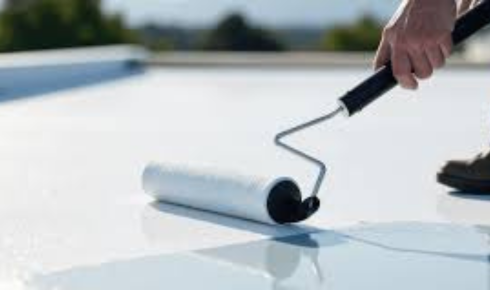
A restoration coating is a liquid-applied membrane, rolled or sprayed over an existing roof, that cures into a continuous waterproof film bonded to the surface below. It re-establishes the watertight layer on a membrane that has weathered and lost its surface integrity, and adds a fresh, reflective, UV-resistant top the old membrane no longer provides.
Done on the right roof, a coating does several useful things at once. It seals the small surface checks and seam weathering that come with age, adds reflectivity that lowers rooftop temperature, and resets the membrane’s exposure clock with a renewable surface that can be recoated again at the end of its life, extending the roof without ever tearing off.
What a coating does not do is fix anything below the surface. If the trouble is in the insulation, the deck, the seams’ structural bond, or the drainage, a coating spans over the symptom without touching the cause. Understanding that boundary is the whole game in deciding whether to coat.
Silicone versus acrylic
The two dominant restoration chemistries are silicone and acrylic, and they suit different conditions. Silicone coatings excel at ponding water; they resist standing water without breaking down, which makes them the go-to for low-slope roofs that hold water in spots despite best efforts at drainage. They weather well under UV. Their downsides are cost and a surface that can hold dirt and get slippery when wet.
Acrylic coatings are water-based, lower cost, and easier to apply and recoat. They reflect well and perform strongly on roofs with positive drainage. Their weakness is ponding: acrylics don’t tolerate standing water and will break down where water sits, so they’re poorly suited to roofs with chronic ponding. They also need a minimum temperature window to cure, which shortens the application season in Calgary.
The choice follows the roof. A roof that ponds wants silicone if it’s a candidate for coating at all; a roof with good drainage can use acrylic and save on cost. A contractor who defaults to one chemistry for every roof isn’t matching the product to the conditions, which is the first sign the restoration was sold rather than specified.
When restoration genuinely pays off
Restoration is the right call when a specific set of conditions holds true together. Miss any one of them and the coating’s value drops or disappears. The conditions are concrete and checkable, which is why a proper restoration starts with an inspection and usually a moisture scan, not a sales quote.
- The membrane is structurally sound and well-adhered, weathered on the surface but not failed.
- The insulation underneath is dry, confirmed by an infrared scan or moisture survey, not assumed.
- The deck is in good condition with no rot or significant corrosion.
- Seams and flashings are intact or repairable to a sound state before coating.
- Drainage works, or ponding is limited enough that a silicone system can handle it.
When all of these are true, a restoration coating can extend the roof 10 to 15 years at roughly half the cost of a tear-off and replacement, with far less disruption to the building below. On the right roof it’s one of the best returns available in commercial roofing, and the recoatable nature of the system means the extension can be renewed again later.
When coating is money wasted
The failure mode is spraying a coating over a roof that needed replacement. The most common and expensive mistake is coating over wet insulation. A coating seals the surface, trapping the moisture in the insulation with no path to dry, and the water keeps corroding the deck and degrading the assembly underneath an attractive new surface that hides the whole problem. The owner paid to make the roof worse and hide the evidence.
Coating also wastes money on a membrane that has failed structurally rather than just weathered. If the seams are delaminating, if it’s no longer bonded to the substrate, or if it’s near the end of its mechanical life, a surface coating doesn’t restore the integrity it’s lost; it bonds to a failing layer and fails with it. Same story with a deteriorated deck: nothing sprayed on top fixes a deck rotting or corroding below.
The tell is always the same: a restoration proposed without an inspection and a moisture scan. A contractor willing to coat a roof sight-unseen, or who waves off a moisture survey as unnecessary, is selling a product, not solving a problem. On a roof with wet insulation, the honest answer is tear-off, and a coating is the expensive way to postpone it while the damage compounds underneath.
The decision process
Deciding between restoration and replacement is a sequence, not a coin flip. It starts with a thorough inspection of the membrane, seams, flashings, and drainage, and it requires a moisture survey to confirm the insulation is dry, because the dryness of the insulation is the single most important input. Skip the survey and the rest of the decision is built on a guess about the one thing that matters most.
If the inspection and scan come back clean, sound membrane, dry insulation, good deck, the math favours restoration strongly, and the conversation moves to which coating chemistry fits the drainage. If the scan finds wet insulation, deck deterioration, or structural membrane failure, the decision is tear-off, and a coating quote should be set aside regardless of how attractive the price looks. The condition data makes the call.
A Calgary roofing contractor who runs that sequence honestly will sometimes talk an owner out of a coating they came in asking for, because the roof doesn’t qualify. That’s the contractor worth hiring. A roof restoration and coatings contractor who scans before quoting is the one who can tell the difference and put the verdict in writing.
Maintenance keeps a coating working
A restoration coating is not a one-time fix that takes care of itself. Like any roof system, it needs maintenance to deliver its full extension. The coated surface should be inspected on the same regular cycle as any commercial roof, with attention to any areas where the coating has thinned, checked, or pulled away at a seam or penetration, and those spots touched up before they let water back in.
The recoatable nature of the system is its long-term advantage, but only if it’s used. A coating maintained and recoated at the right point keeps extending the roof; a coating sprayed and then forgotten weathers down to the old membrane and the extension is lost. Building the inspections and eventual recoat into a maintenance agreement is how an owner banks the years the restoration promised, and it also protects the coating warranty, which usually carries upkeep requirements a missed cycle can void. The coating extends the roof; the maintenance extends the coating.
The roof underneath decides
Restoration coatings are neither a miracle nor a scam. They’re a precise tool that delivers excellent value on a sound, dry, weathered roof and nothing but hidden damage on a roof with wet insulation or a failing deck. The coating never decides the outcome; the condition of the roof underneath it does, and that condition is knowable before a drop of coating is sprayed.
So the order is non-negotiable: inspect and scan first, then decide. A dry, sound roof with surface weathering is a strong candidate for a silicone or acrylic restoration that buys a decade or more at half the cost of replacement. A roof with wet insulation needs tear-off, and no coating changes that. Work with a Calgary commercial roofing contractor who confirms the condition before quoting, and the coating goes only on the roofs where it actually pays.
About the author — this article was contributed by the team at Superior Roofing Ltd., a Calgary-based commercial roofing contractor with 25+ years of experience and HAAG Certified inspectors. The team scans roofs before recommending restoration, installs silicone and acrylic coating systems where they fit, and carries $10 million in liability coverage across Alberta projects.